
I have been asked before, “How do I know how long to cook things in my slow cooker?”
I like to say that you know your slow cooker best, but maybe you don't know how to test it. If you have ever pulled out dry chicken, undercooked beans, or soup that somehow boiled on the warm setting, you know that guesswork only gets you so far.
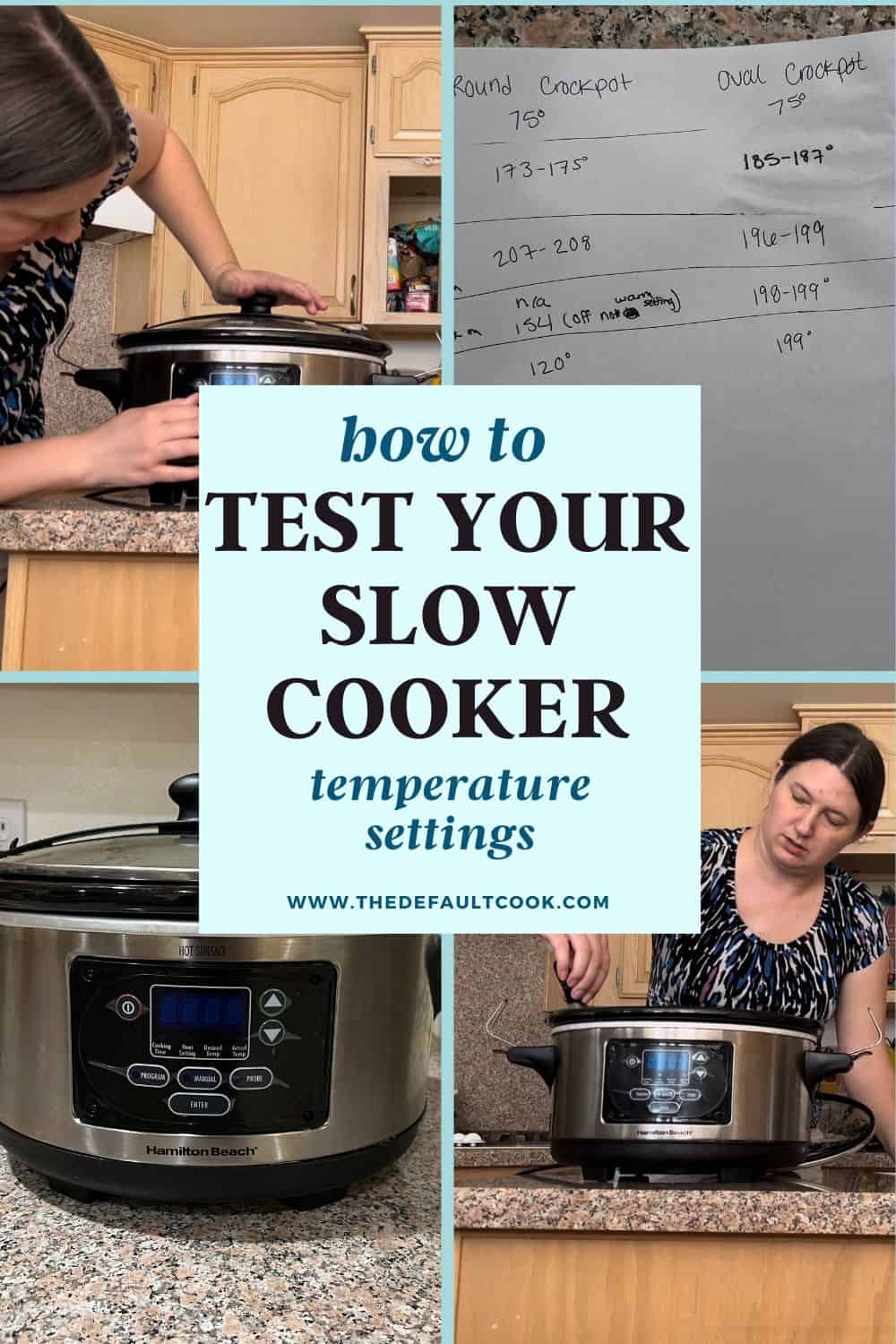
The truth is, slow cookers all heat a little differently. Some run hot, some stay cooler, and some have a warm setting, but what temperatures are those actually running at? Testing slow cooker performance with water and a basic thermometer gives you real numbers, so you can cook safely and confidently instead of hoping for the best.
Today we'll walk through a simple at-home test using three slow cookers: two Crock-Pots (one round knob style, one oval shape programmable) and one Hamilton Beach programmable model. You will see how their low, high, and warm settings actually perform, and how to repeat the same test in your own kitchen.
This post contains affiliate links, and spoiler alert, the Hamilton Beach performed the best.
Why Bother Testing Your Slow Cooker?
If you have ever followed a cooking recipe to the letter and still gotten weird results, your slow cooker might be the reason, not the recipe.
Many home cooks use "Crock-Pot" as a catch-all word, the way we say Kleenex for tissues. Crock-Pot is a brand, and in this test, two of the cookers are Crock-Pot models and one is a Hamilton Beach. All three are standard slow cookers, not multi-cookers or pressure cookers.
The goals of this test are simple:
- Find out how hot each setting (low, high, warm) really gets.
- See which cookers perform hotter or cooler than the others.
- Decide which is the best slow cooker for which type of recipe.
Knowing your temperatures helps you:
- Avoid a warm setting that boils your food, which can dry out tender dishes.
- Compare different cookers you already own, so you pick the best one for each recipe.
- Make smarter buying decisions, especially if you are replacing an older model or adding a second cooker.
It is also about food safety. You want your cooker to keep food hot enough to stay out of the danger zone, but not so hot that everything overcooks.
You do not have to be a food scientist for this. A simple test gives you the confidence that your favorite chili, soup, or roast is cooking safely in the background while you live your life.
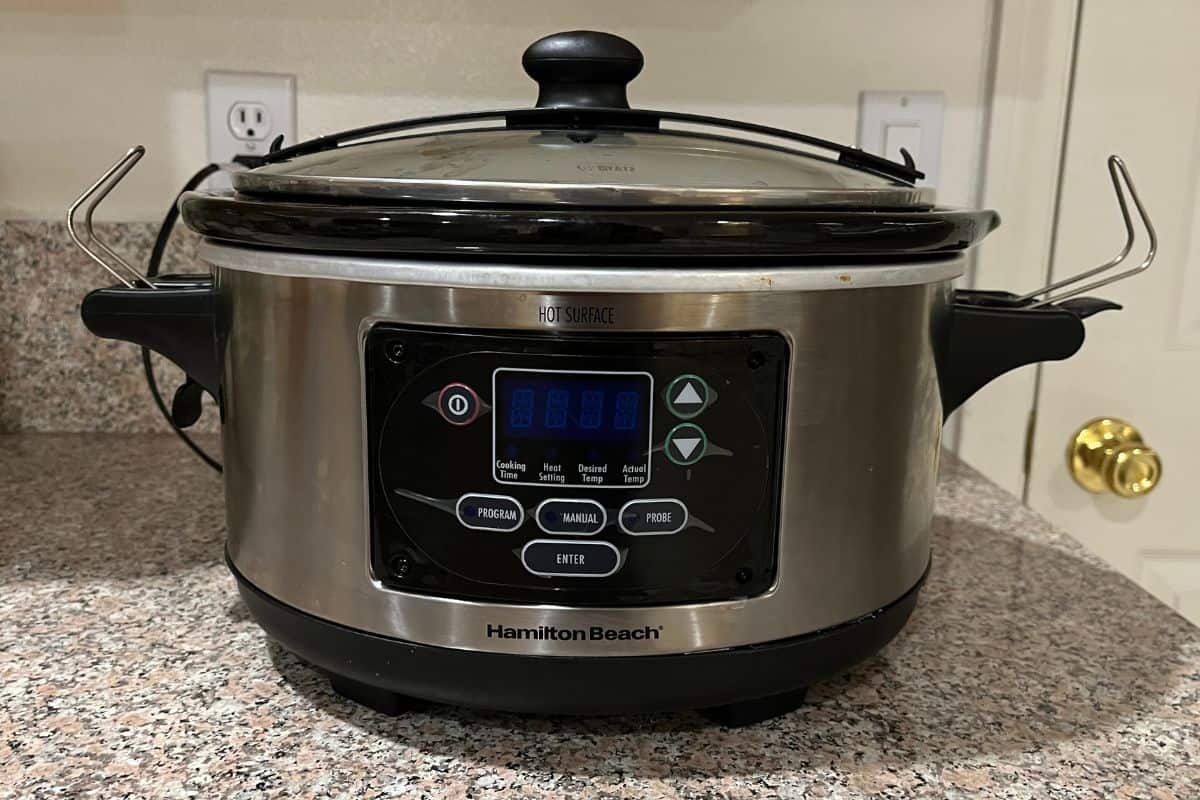
What You Need For The Slow Cooker Temperature Test
This is a very simple setup. You only need a few basic tools you probably already have.
- Slow cooker(s): At least one slow cooker to test. Three were used in this test for comparison, but one is enough to learn a lot.
- Water: Room temperature. Four cups work well for most standard inserts with 5 to 7 quart capacity and gives a consistent volume. At minimum, aim for 1 to 2 inches of water so it does not evaporate and you can get a good reading.
- Food thermometer: A simple temperature probe. It does not need to be fancy or expensive. The one used here was under $10 when it was bought years ago.
- Timer or clock: Your phone, oven timer, or a watch works fine. You need to track how long each setting has been running, usually 1 to 2 hours.
If you are testing more than one slow cooker, it helps to label your notes by shape, brand, or model, so that you know which temperature goes with which slow cooker.
Do not clamp the locking lid using the travel clips while cooking. Those clips are only for travel. Clamping them while the cooker is on can trap too much pressure, stress the glass, and may damage the lid. For this test, keep the lids resting on top, not locked down, so steam can escape normally.
Setting Up The Test
Start each slow cooker with the same amount of water and the same starting temperature so your results are fair and easy to compare.
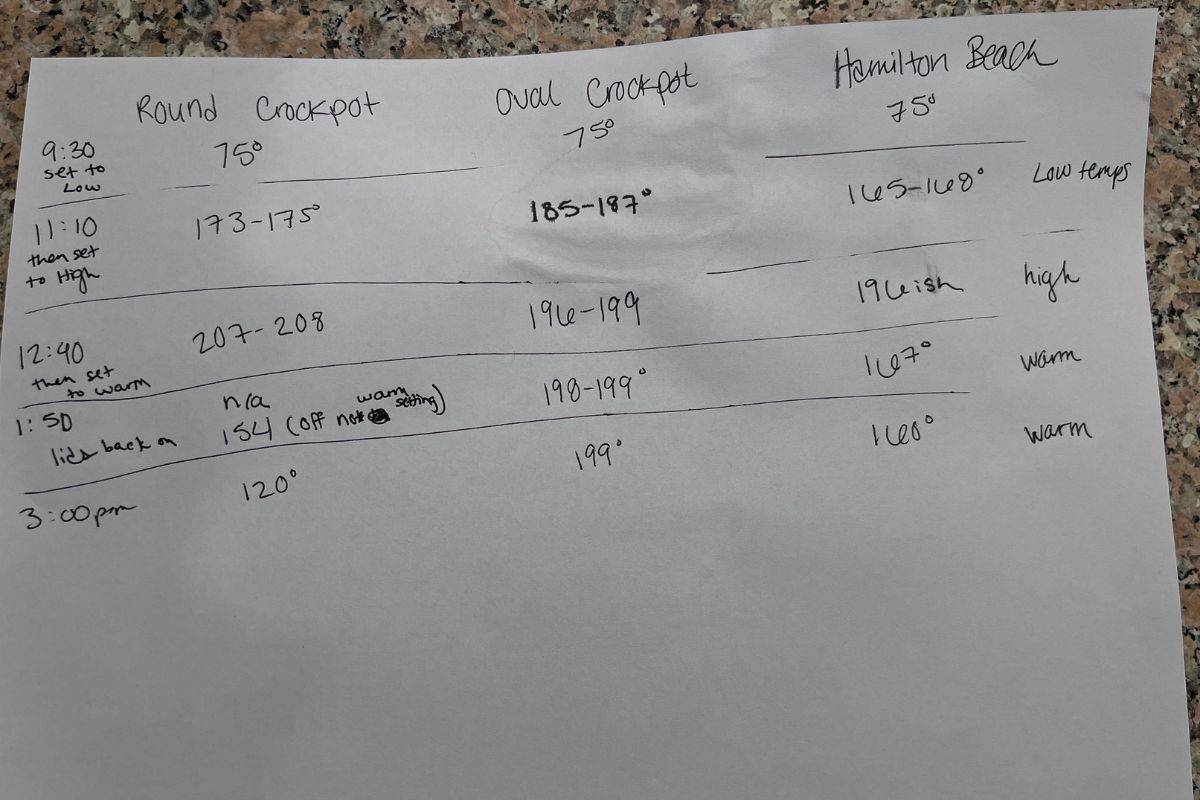
In this test, each insert was filled with 4 cups of room temperature water. The starting temperature of the water in all three slow cookers was 75°F.
Here is the basic setup, which you can copy at home.
- Pour water into your slow cooker until you reach at least 1 to 2 inches deep. Four cups is a good minimum for a typical 5 to 7 quart insert.
- Check the starting water temperature and write it down. Room temperature is perfect.
- Turn the slow cooker to the low setting.
- Put the lid on, but do not latch any travel clips.
- Set a timer for at least 1 hour, and ideally 1½ to 2 hours of cooking time, to give the cooker time to reach a steady temperature.
Water heats evenly in ceramic inserts, so once it has been on for long enough, the temperature across the pot will be quite even. You do not need to hover. Condensation on the lid is a good sign that things are heating up. In this test, condensation started around 45 minutes and was noticeable on all three lids by 1½ hours.

Handling Different Types Of Slow Cookers
Each slow cooker has its own controls, so the exact button you press may differ, but the idea stays the same.
- Round Crock-Pot: Uses manual controls with a simple dial. Just turn it to "Low."
- Oval Crock-Pot: Digital programmable. Switch to manual, select "Low," and set more hours than you need so it will still be running when you check. Here, it was set for 3 hours.
- Hamilton Beach oval: Also a digital programmable model. Select "Low" and, if running on a timer, set it long enough that it will not switch to warm during testing.
Once they are all set to low with lids on, let them run while you go about your day. You only need to come back to check temperatures.
Testing The Low Setting
After about 1 hour and 40 minutes, the water was ready to check. All three lids had plenty of condensation, which is a good visual cue that the cookers were up to temperature.
How To Take An Accurate Reading
Turn on your thermometer and place the probe into the water, not touching the bottom or sides of the insert. The ceramic may read differently than the water itself, so if the probe touches the crock, you can get an inaccurate reading.
Move the probe to a few spots, such as near the side and near the center, to make sure the temperature is consistent. A variation of 2 or 3 degrees is normal. A gap of 10 degrees or more would be more concerning. You also want to do this relatively quickly, the water will cool down a bit naturally with the lid off.

Low Setting Results
Here is what the three slow cookers reached on Low after about 1 hour and 40 minutes:
Round Crock-Pot: 173°F to 175
Oval Crock-Pot: 185 to 187°F
Hamilton Beach Oval: 165 to 168°F
A few clear patterns show up right away:
- The oval Crock-Pot slow cooker runs the hottest on low, close to 185 to 187°F.
- The Hamilton Beach slow cooker runs the coolest on low, closer to 165 to 168°F.
- The round Crock-Pot sits in the middle, mid 170s.
All three are hot enough for safe cooking, but their performance on the low setting is not the same.
If you have ever wondered why a recipe says “8 hours on low,” but your food is done and falling apart at 6, this kind of difference may be the reason.
With results like these, the oval Crock-Pot looks like a good pick if you want to start something at lunchtime and have it ready on the early side. If you want a long, gentle cook while you are gone all day, the cooler Hamilton Beach is better.
After noting the low temperatures, all three slow cookers were switched from low to high.
Testing The High Setting
Since the water was already very hot from the low setting, it did not need as long to climb to the high temperature. The cookers were left on high for about another 1½ hours before taking readings.
Again, the thermometer was kept off the bottom of the insert, and the lid was lifted only as long as needed since the water cools quickly once the lid is off.
High Setting Results
Here is what each slow cooker reached on High:
- Round Crock-Pot: 207 to 208°F
The water was clearly boiling. Since water boils at 212°F, we cannot measure water temperature any higher in a home setting and the temperature is likely higher when cooking. That slow cooker was turned off after the reading, because there were no more settings to test on it. - Oval Crock-Pot: 196 to 199°F
That is only about 11 to 12°F higher than its low setting, which had been around 185 to 187°F. - Hamilton Beach oval: About 202°F initially, then settling around 196°F likely from the lid being open. This one had a wider gap between low and high, since its low temperature was in the mid to high 160s.
As the thermometer probe moved around, there were small changes, usually just a few degrees. Once the lids were off for a bit, the water temperatures dropped a bit more, which is normal.
If the probe touches the bottom, your readings can jump higher than the actual water temperature, so make sure the tip is fully in the water, floating above the base unit. The heating element in the base unit makes the ceramic hotter. However, it is difficult to get an accurate temperature reading with a food probe on a ceramic surface, so that data is not great for comparing slow cookers. This is why we record the water temperature.
The goal here is not perfection, just a good sense of how your slow cooker behaves. Even rough numbers will help you choose the right setting and timing with a lot more confidence.
Next up was the warm setting, which turned out to be the real surprise.
Testing The Warm Setting
Only the two digital programmable models, the oval Crock-Pot and the Hamilton Beach, had a keep warm function. The round Crock-Pot did not.
After checking the high temperatures, both digital programmable models were switched over to Warm. The lids were left off briefly to let a bit of steam escape, to bring them closer to the same starting point. At that moment, both were around 190°F.
The round Crock-Pot was turned off completely for comparison.
First Warm Check After About 1 Hour
After about an hour on warm, the temperatures were checked again.
- Oval Crock-Pot on Warm: 198 to 199°F
This is almost identical to the high temperature. It explains why food seemed to boil even when it was set to warm. In this particular slow cooker, warm is not a gentle holding setting, it is basically another high. - Hamilton Beach on Warm: Around 167°F
This matched its low setting from earlier, which had been in the high 160s. Warm on this model behaved more like a low setting after 1 hour. - Round Crock-Pot turned off: About 154°F
This was just a comparison to see how much heat the ceramic insert holds after the power is off.
Second Warm Check After A Bit Over 2 Hours
After a little more than two hours on warm, the temperatures were checked again.
- Oval Crock-Pot on Warm: Still around 199 to 202°F
Even after more time, it continued to hold a high level of heat. Warm on this model is effectively the same as high once it settles in. - Hamilton Beach on Warm: Around 160°F
It had dropped a few more degrees from the first check, but stayed safely above 140°F. - Round Crock-Pot turned off: Around 120°F
This makes sense since it had been off the whole time and was just slowly cooling toward room temperature.
From a food safety perspective, keep warm functions should hold food above about 140°F, so it stays out of the temperature danger zone where bacteria grow quickly. The Hamilton Beach keep warm function did this very well without continuing to actively cook the food. The oval Crock-Pot warm function, on the other hand, went higher than it's low cooking temperature.
If you had a long cooking recipe like pulled pork or a roast in that oval Crock-Pot, and it auto switched from low to warm, the temperature would actually rise compared to low, not fall. That is important to know if you are relying on the keep warm function to keep food ready without overcooking.
What These Results Mean For Your Cooking
These tests show that slow cookers with the same labels on the dial do not behave the same way. "Low," "High," and "Warm" are not universal.
Here are some practical ways to use this information in your own kitchen for everyday cooking:
- Older models may run hotter on warm
If your slow cooker has been with you for many years and you notice food boiling on warm, it might be behaving like that oval Crock-Pot. Testing it gives you proof. - Use cooler running models for all day, low and slow cooking
The Hamilton Beach ran cooler on low and had a true warm that hovered around the 160°F range. That makes it great for recipes that cook while you are gone all day. - Use hotter models when you need a faster cook
The Crock-Pot, with its hotter settings, is better suited for shorter cooking times when you want to make sure food is fully cooked in less time. - Keep one slow cooker as a holiday "warmer"
If you own more than one, you can dedicate one to keep mashed potatoes, sides, or sauces hot during holidays. A cooker with a solid warm setting that holds between 150°F and 170°F is perfect for that, and it simplifies cleanup since it's reserved just for warming. - Programmable cookers are handy if you are away from home
Being able to set a timer or use a probe that switches the cooker to warm once a temperature is reached can be very helpful and easy to use. From the three tested here, the best performer, and the one I would buy again, is the Hamilton Beach Set & Forget 6 quart slow cooker.
How To Test Your Own Slow Cooker
You can and should repeat this test with your own slow cooker. It takes some time, but very little hands on effort.
Here is a simple guide:
- Put at least 1 to 2 inches of room temperature water in the insert.
- Check and note the starting temperature.
- Turn the cooker to Low, put the lid on (unclipped), and let it run 1½ to 2 hours minimum.
- Check the temperature in several spots, keeping the probe off the bottom and sides.
- Repeat the same process for High, starting with hot water from the low test, and give it about an hour or so to settle.
- If your cooker has Warm, switch to warm from high and check it after 1 hour, then again after 2 hours.
Keep your notes with your favorite recipes, or even tape them inside a cabinet door for quick reference. Over time, you can retest if you suspect your cooker is changing with age.
Final Thoughts On Safe, Confident Slow Cooking
With nothing more than water, electricity, and a simple thermometer, you can answer a lot of questions about your slow cooker. You do not have to guess whether low is hot enough, high is too much, or warm is really safe; you can measure it. This straightforward process makes the appliance easy to use with full confidence.
Knowing the real temperatures behind those settings makes your recipes more reliable and helps keep your food safe. It lets you choose the right cooker for the right job, whether that is an all day pot roast, a quick batch of shredded chicken, or a bowl of mashed potatoes waiting through the holidays.
If you try this test on your own slow cooker, write down what you find and use it the next time you plan a meal. You are doing more than cooking; you are taking care of the people at your table, and you are doing a great job at it.
Janet G says
This was a very interesting read. I have a Hamilton Beach slow cooker and it seems to cook hot. A chicken breast recipe using fresh, not frozen, typically calls for 6-8 hours on low. Mine are always done in 3 on low. I'm searching for a slow cooker with the most accurate temps and enjoyed reading your test results.
Thanks!
Bill johnson says
I'm getting rid of my Gem Instant Pot. I put a two pound corn beef, carrots, onions and potato's in the pot and set it on slow cook. When it was 10 hours I tested it for tenderness like the internet said. A fork should go into it effortlessly. It didn't. I took my instant read thermometer (a real instant read one) and it was reading 195. I switched the pot to high, it was reading 189. I decided to use the setting for stew because I can adjust the temperature from 175 to 210 I set it to 210 and it boiled, I set it to 200 it boiled, and finally set it on 175 and it kept boiling. I switched back to slow cook for and hour and had pulled corn beef ( a little over cooked). My wife hated this from the day I bought it. I use Thermapen® ONE. I just bought the one you have as a wedding present, I'm testing it right now.
Anne Aslanides says
I've not used a Gem Instant Pot, but I've used a regular Instant Pot and while it is great for pressure cooking, I find it subpar when it comes to slow cooking. I hope your slow cooker worked much better than the Gem for you!
MarkD says
Well I disagree with the basic premise of this measurement, because it was done with only water. fat melts at a much higher temperature and so will continue to receive heat and increase in temperature the longer heat is applied to it. Now as we know, this makes a difference for meats because if you want to have that fall off the bone tenderness, you need sustained. of heat in excess of 220, because for beef which is my example, connective tissue does not begin to melt until you hit 225 (I think that's just a tad conservative for for that matter). so you will not get softer and less tough and more fall off the bone delightful until after the temperature has begun to reach 225 and then it takes of course a couple hours at that temperature at least. Thanks!!!
Anne Aslanides says
Thanks for the thoughtful comment, Mark! The goal of this test wasn't to recreate every type of food someone might cook. I was primarily trying to compare the heating behavior of different slow cookers under the same conditions to see whether any of them ran unusually hot or cool.
You're right that fats have different thermal properties than water, and it would be interesting to repeat the experiment with a fat like canola oil to compare maximum temperatures. For this experiment, though, water was a deliberate choice because it's added to many slow cooker recipes, is easy for other home cooks to replicate (and without washing their slow cooker afterward!), and let me compare the appliances using a simple, consistent medium.
As for tenderness, that's where time and temperature work together. Connective tissue begins breaking down well below 220°F, but it happens gradually over time, which is why tougher cuts can become so tender after several hours in a slow cooker even without the meat reaching 220°F internally. If you end up trying this experiment with another medium, I'd genuinely love to hear what you find!
Pamela says
I'm trying to cook chicken broth for 20 hours. With the oval digital slow cooker on low, it boiled after a few hours. Is a low boil going to decrease the medicinal value of the broth?
I think I will look at purchasing the Hamilton. That's all I will use a crock pot for. What are your thoughts?
Anne Aslanides says
I can't speak to the medicinal value of chicken broth or how different cooking temperatures might affect any specific health benefits, but I can speak to the cooking side. While the Low setting generally runs cooler than High, some slow cookers will still eventually reach a simmer or low boil on Low. Based on my testing, the Hamilton Beach may be a better option for a lower temperature, though whether it reaches a boil can vary even within the same slow cooker model, from slight variations in the appliance to the altitude you're using it at.